AI in Venture Building: What Gets Faster, and What Doesn’t
AI has made parts of venture building dramatically cheaper. Not the parts that decide whether a new venture works. Knowing the difference is where the budget goes right or wrong.

Every corporate innovation deck now has a slide about AI. The promise is usually the same: new ventures in weeks instead of years, with smaller teams and less risk.
Part of it is true. The part that isn’t true happens to be the expensive one.
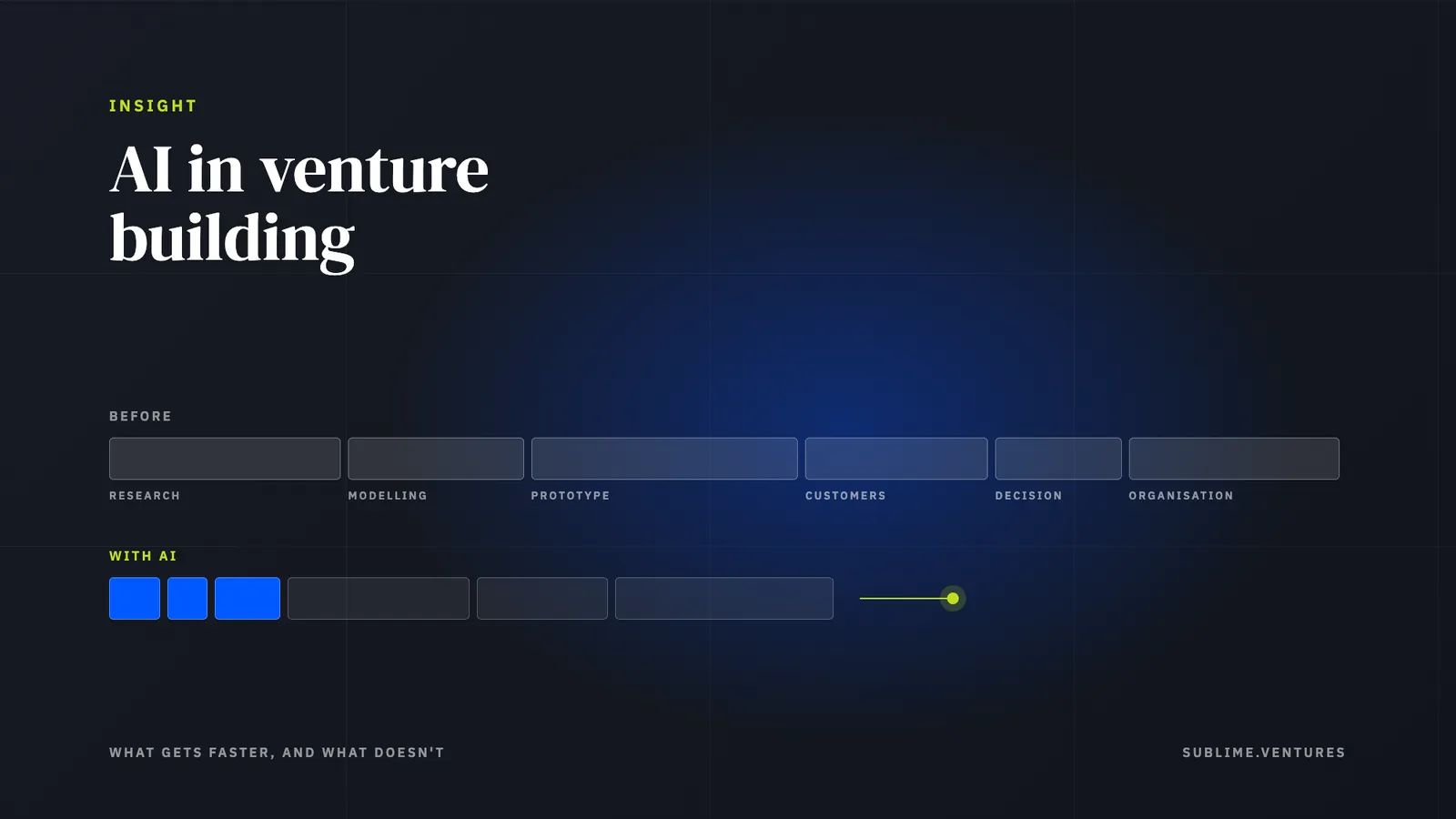
AI has made some steps of venture building dramatically cheaper. Research, modelling, the first versions of a product. Other steps have not moved at all, and they are precisely the ones that decide whether a new venture works. If a budget is planned as if everything got faster, the savings end up in the wrong place and the risk stays exactly where it was.
Where AI really compresses the work
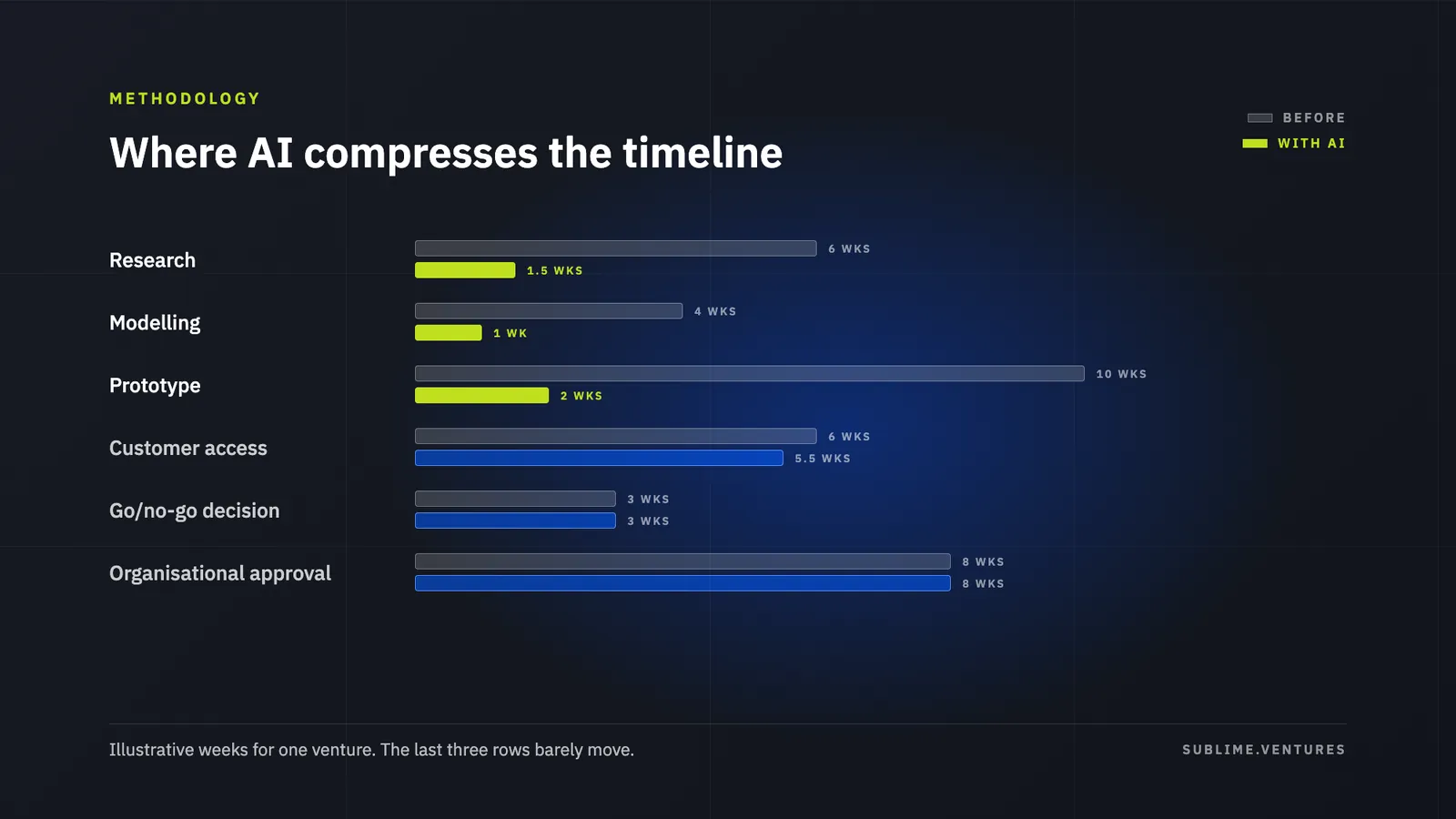
Research. A competitor scan that used to take a week of desk research can be drafted in an afternoon. Two hundred app reviews, forty interview transcripts, a stack of industry reports: AI reads them faster than any analyst and pulls out the recurring themes and, more usefully, the contradictions. The first pass is no longer the bottleneck.
The limit is worth saying plainly. AI summarises what people said. It does not know what they will do, and it cannot tell a polite answer from a real intention. The synthesis is a starting point for the next question, not the answer.
Modelling. Market sizing and unit economics used to live in spreadsheets that nobody dared to touch once they worked. Now the models update the moment an assumption changes, and running a best and a worst case takes minutes. That changes the conversation: instead of defending one number, the team can see which assumption moves the result most. That is the one to test first.
Building to learn. This is the largest shift. Once the market maths holds and the problem is clear enough for a solution to follow from it, a working prototype can be ready in days rather than months. Not a product. Something good enough to put in front of real users and observe what they do.
What doesn’t get faster
Access to the right customers. Nobody’s calendar got shorter. Twenty conversations with the buyers who actually decide still take weeks to organise, and they are still the most valuable hours in the whole process. AI can prepare the interview guide. It cannot sit in the meeting.
The decision. AI will produce ten plausible reasons why a venture could work and ten why it could fail. Deciding which assumption would bring everything down, and whether the evidence is strong enough to spend real money, remains a call someone has to own. The go/no-go does not get faster because the slides got faster.
The organisation. In a corporate, the slowest step is rarely the research. It is the budget cycle, the steering committee, the approval that waits for the next board meeting. A prototype built in four days that waits three months for a decision has not saved anything. This is usually where AI programmes stall too: not on the technology, but on mandate, governance and data.
Trust. Buyers still buy from people. Especially in B2B, where the first customer takes a risk by saying yes.
The new risk: building faster than you learn
Because building has become cheap, teams now build before they know. The cost of a prototype dropped. The cost of building the wrong thing did not, because most of that cost was never the code. It is time, attention and a team that grows attached to what it made.
A prototype that took an afternoon is still a prototype someone will defend in the next meeting.
So the discipline matters more than before, not less. Every test still needs a metric and a threshold fixed before it starts. The speed is only an advantage if it shortens the distance between a question and its answer. If it only shortens the distance between an idea and a demo, it has made the old mistake quicker.
How we use it at SUBLIME Ventures
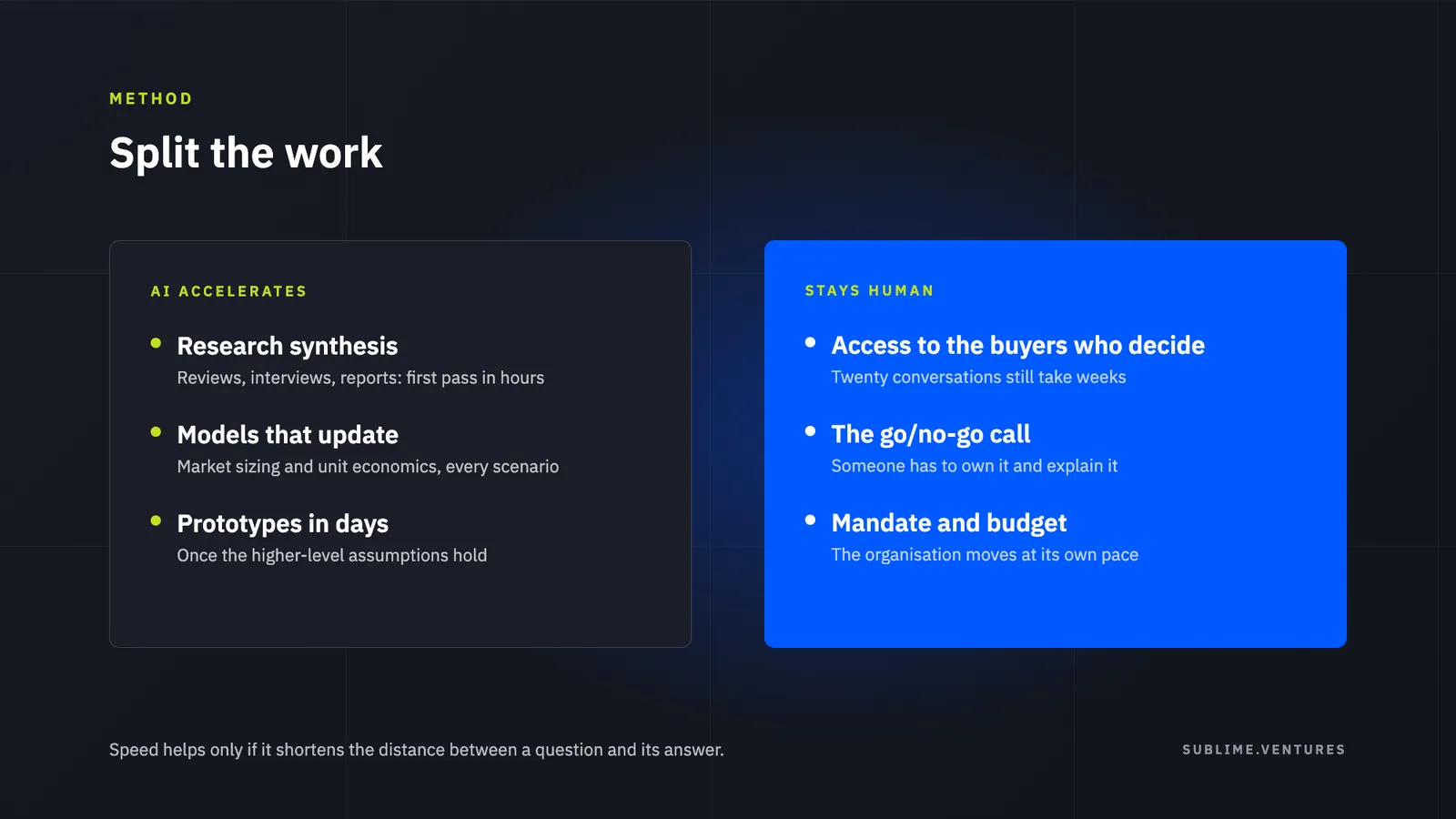
We use AI where it removes weeks without removing judgement. Desk research and the first synthesis of interviews, always checked against a primary source before anything is decided on it. Market and unit economics models that update instead of spreadsheets that freeze. Quick prototypes, but only after the higher-level assumptions have held, never as a way to skip them.
What we keep human is the part that carries the risk: talking to the buyers, reading what they do rather than what they say, and making the call. When a venture should stop, that call still needs someone willing to make it and to explain why.
AI doesn’t remove the uncertainty of a new venture. It removes the excuses for not testing it early.
If you want to see how ready your own organisation is, on mandate, operating model, data and talent as much as on AI, the Corporate Venture & AI Readiness Diagnostic takes five minutes. And if there is an initiative on the table, the next step is a 30-minute conversation.