The Execution Myth: Why Venture Building Starts with De-Risking
“Ideas are worthless; execution is everything” is one of innovation’s most expensive beliefs. Structured de-risking turns opinion into evidence, and sometimes the best decision is to stop in week one.

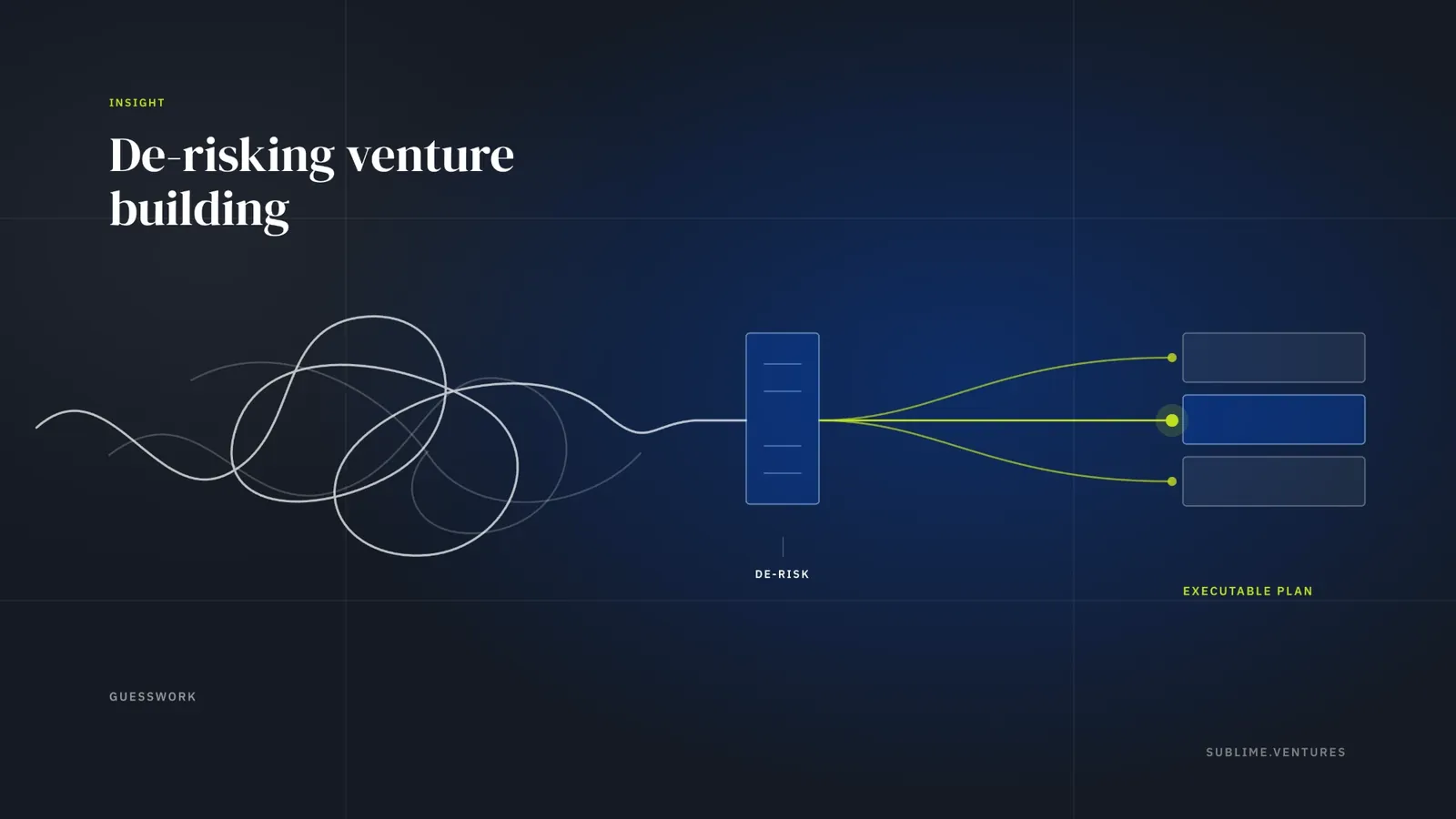
“Ideas are worthless; execution is everything.” It is one of the most repeated lines in innovation. It is also one of the most expensive.
It has led plenty of teams to disappear for months, building flawless products that nobody wanted to buy. The code was clean, the design polished, the team fully committed. The only thing missing was a market.
The idea was born in Silicon Valley and crossed into Europe largely unexamined. The premise is simple: work well enough, for long enough, and sooner or later the market responds. Across dozens of projects, we have often seen the opposite. So at SUBLIME Ventures we start from a different premise. In the early stages of a new venture, the goal is not to build a product. It is to rule out the wrong assumptions, one after another. That work has a name: de-risking, which means reducing risk systematically before the money goes in.
Launching a new initiative, whether a spin-off inside a company (corporate venturing) or an independent startup, means managing uncertainty. Every untested assumption is capital at risk, and the exposure grows with time. New ventures rarely fail because the team can’t build the solution. Far more often, they fail because they build something nobody was looking for.
The anatomy of risk: what it takes to stop guessing
Every new business idea rests on a stack of hunches. The buyer is probably the HR director. They will probably pay €50 a month. The market is probably big enough.
None of these statements is false to begin with. The problem is that none of them is true yet. Venture building exists to turn them into data, by attacking risk on three fronts.
- Market risk (Desirability: does anyone actually want it?). The problem has to be real, and painful enough that people actively look for a solution. Not a minor irritation they are happy to live with.
- Business model risk (Viability: do the economics hold up?). The cost of acquiring a customer (CAC) has to stay well below the value that customer generates over time (LTV, or lifetime value). And the reachable market has to justify the investment. This is where TAM, SAM and SOM come in: the total market, the portion the business can realistically serve, and the share it can realistically win in the first few years.
- Technical risk (Feasibility: can it be built and scaled?). The solution has to work with the technology, AI and resources available, and scale at operating margins that hold up.
The order is deliberate. Technical risk is the most familiar, which is why teams tend to tackle it first. Yet it is rarely what sinks a project, so we put it last.
The method: validation sprints and decision thresholds
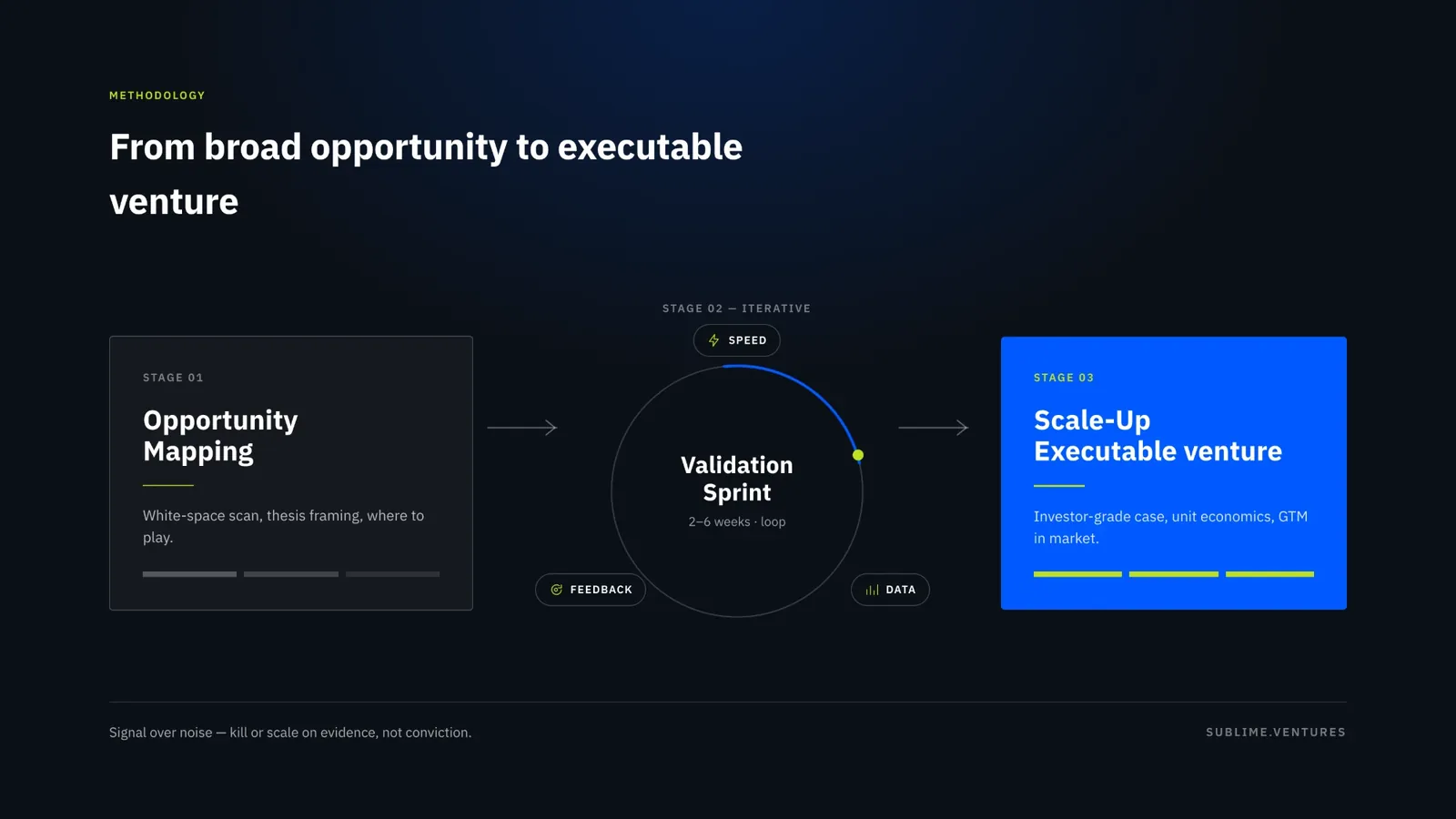
Rather than funding months of development in the dark, we work in validation sprints: short test cycles, each with one hypothesis and one metric. Before a single line of production code is written, we map where the risk sits and tackle it in sequence, starting with the assumption that would bring everything else down if it turned out to be wrong.
The first step is to stress-test the business model. Using interactive tools such as the Business Model Canvas and the TAM SAM SOM calculator, we size the market from two directions: top-down, starting from industry data, and bottom-up, starting from realistic customers, prices and volumes. If the two estimates don’t converge, an assumption needs revisiting. The tools are not static spreadsheets: they are models that update the moment an assumption changes. The work takes days, not weeks.
The second step puts the value proposition in front of real users. A landing page that measures how many people leave their details for a product that doesn’t exist yet. A throwaway prototype, built to observe behaviour rather than to look good. Every test has a metric and a threshold fixed before it starts, so the result can’t be reinterpreted after the fact.
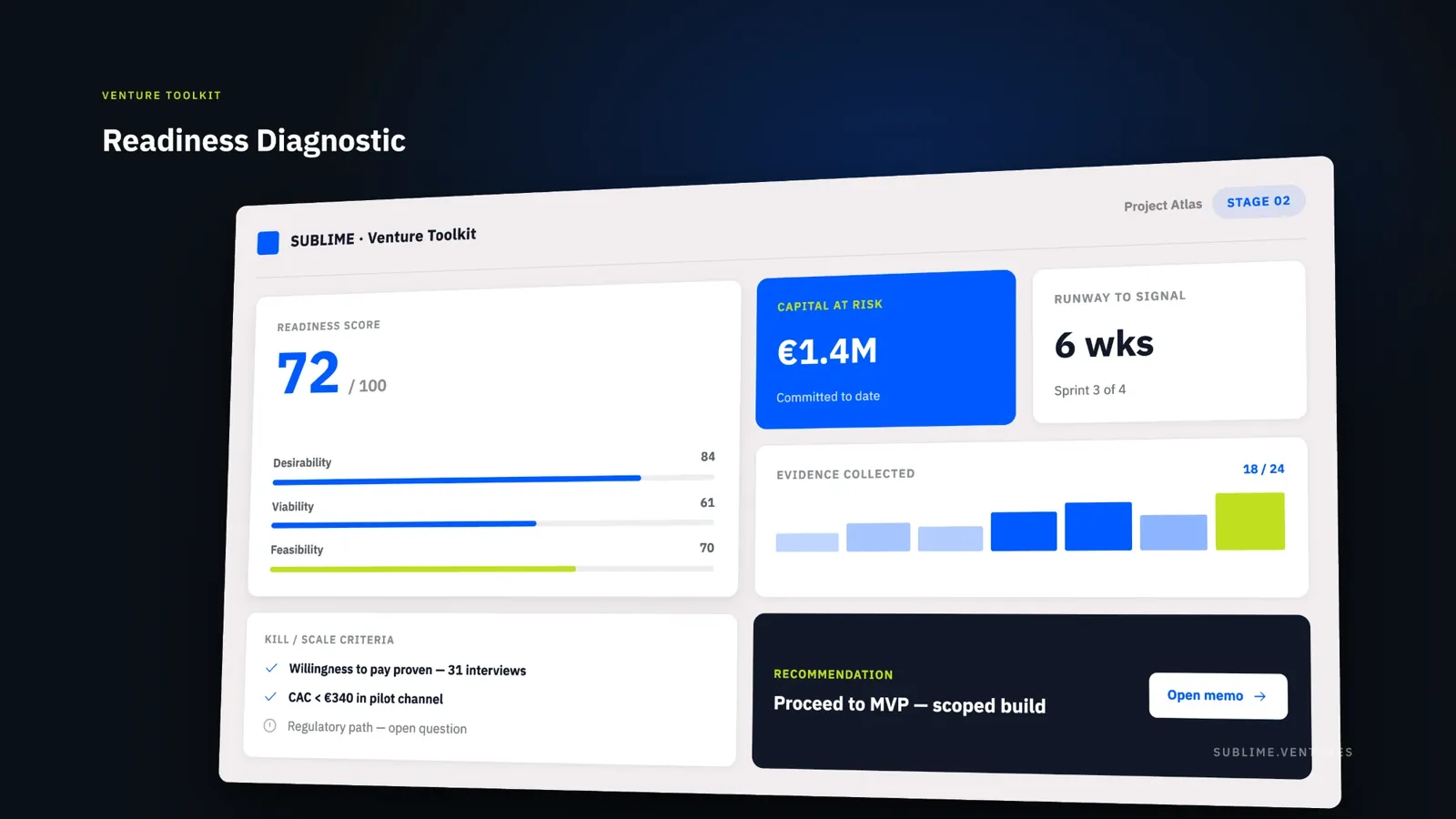
The third step is the decision. We use a de-risking scorecard with explicit confidence thresholds for each of the three risks. An opportunity moves into technical development only once it clears them. Otherwise the go/no-go call — the decision to proceed or stop — becomes a no. And a well-argued no is a result, not a failure.
A concrete example. While assessing a new venture for a client, we identified critical gaps in both desirability and economic viability. Our recommendation was not to proceed. That decision saved the client an estimated €2 million or more in potential losses.
No product launched, no story for a pitch deck. Just capital that was never burned.
A well-argued no is a result, not a failure.
Corporate venturing and AI: where it gets harder
Inside an established company, this method meets an extra obstacle. Large organisations have resources, but they are built to protect the core business, not to question it or to move at startup speed. Long approval chains, annual budgets and metrics designed for the existing business slow down precisely the tests that matter most.
So before a project is launched, there is a preliminary step: establishing whether the organisation can genuinely build and sustain a new venture. That is what the Corporate Venture & AI Readiness Diagnostic is for. It maps the decision-making, technology and strategic bottlenecks before they become the reason a good project stalls.
In this work, AI is not only the product being sold. It is a research tool. We use it to speed up competitor analysis, to synthesise user interviews by surfacing recurring themes and contradictions, and to model acquisition-cost scenarios before a single euro is spent on campaigns. It doesn’t replace judgement. It shortens the distance between a question and an answer that can be checked.
Build to learn
Innovation is not a stroke of genius in the shower. It is a disciplined process of capital allocation. De-risking exists to turn uncertainty into calculated risk, as early as possible.
If an idea is going to fail, there is a moral and fiduciary duty to make it fail in the first week of testing, when the mistake costs almost nothing. Not in month six of development, when the budget has already been spent.
It is the same logic as the €2 million case: stopping before the investment costs far less than stopping after it.
Venture building done well is a bridge across uncertainty: every pier is load-tested before the whole budget is driven across it.
If there is an initiative on the table and the question is which assumption to test first, the next step is a 30-minute conversation.