Fast, good, cheap: with AI you no longer have to pick two, if someone checks the work
Of price, quality and time, you used to get two. With AI you can now have all three, but the corner that decides the outcome is a different one: whoever checks the work.

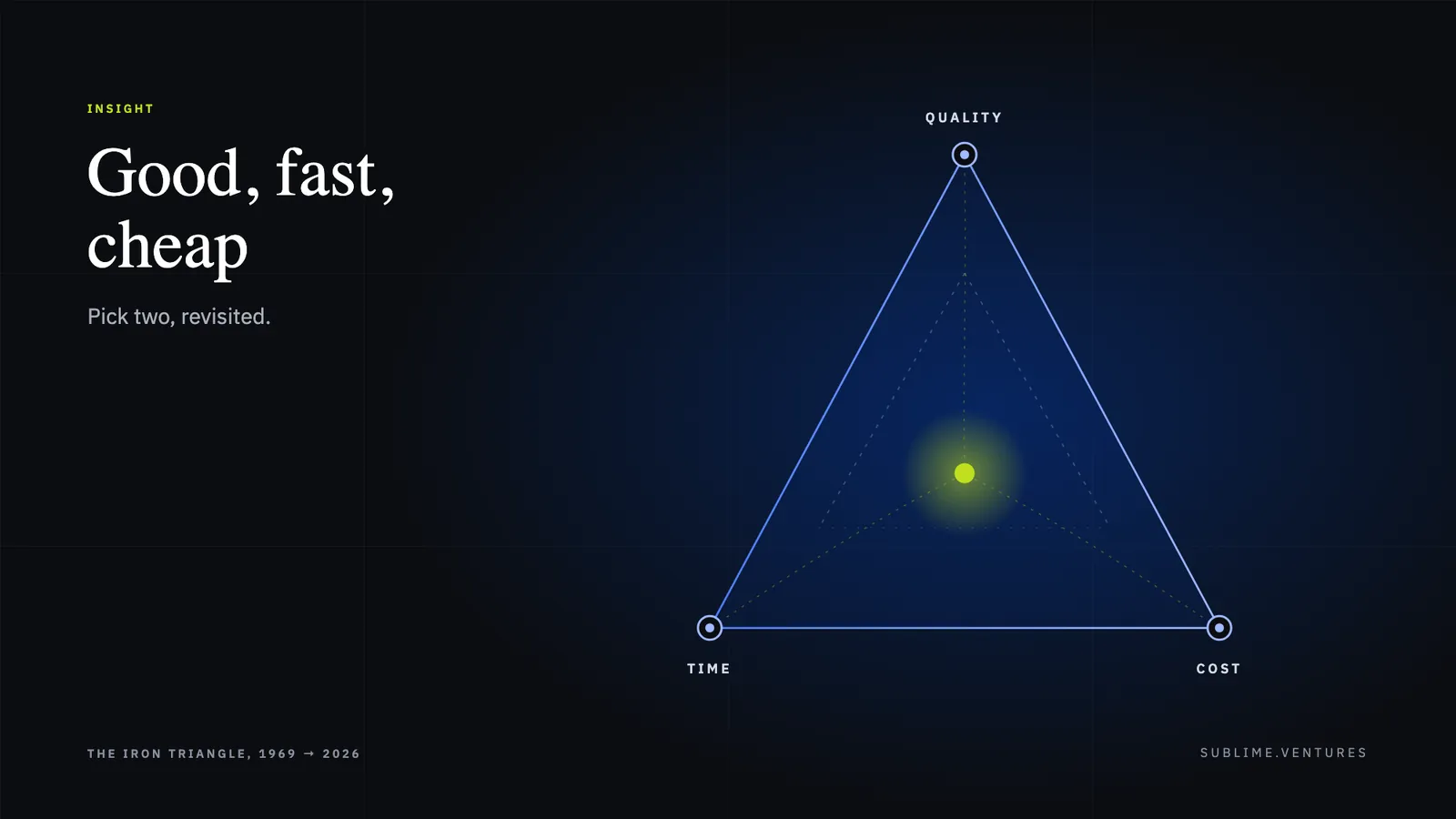
Anyone who has commissioned a website, a warehouse or a business plan knows the rule. You want it good and fast? It will cost you. Good and cheap? It will take time. Fast and cheap? Then don’t complain about the quality. Of the three, you get two.
The rule has a traceable history. In 1969 the British engineer Martin Barnes, later one of the founders of the Association for Project Management, was running a course when he drew a triangle with time, cost and quality at its corners and slid a coin across it: moving the coin towards one corner moved it away from the others. He told the story himself. The shop-floor version, “fast, good, cheap: pick two”, already appears in 1980.
The triangle held for half a century for an economic reason: quality was made of hours of expert work, and hours cost money and pass at a fixed speed. That is precisely what generative artificial intelligence changes. The question is whether it changes it enough to break the rule.
The three corners move together
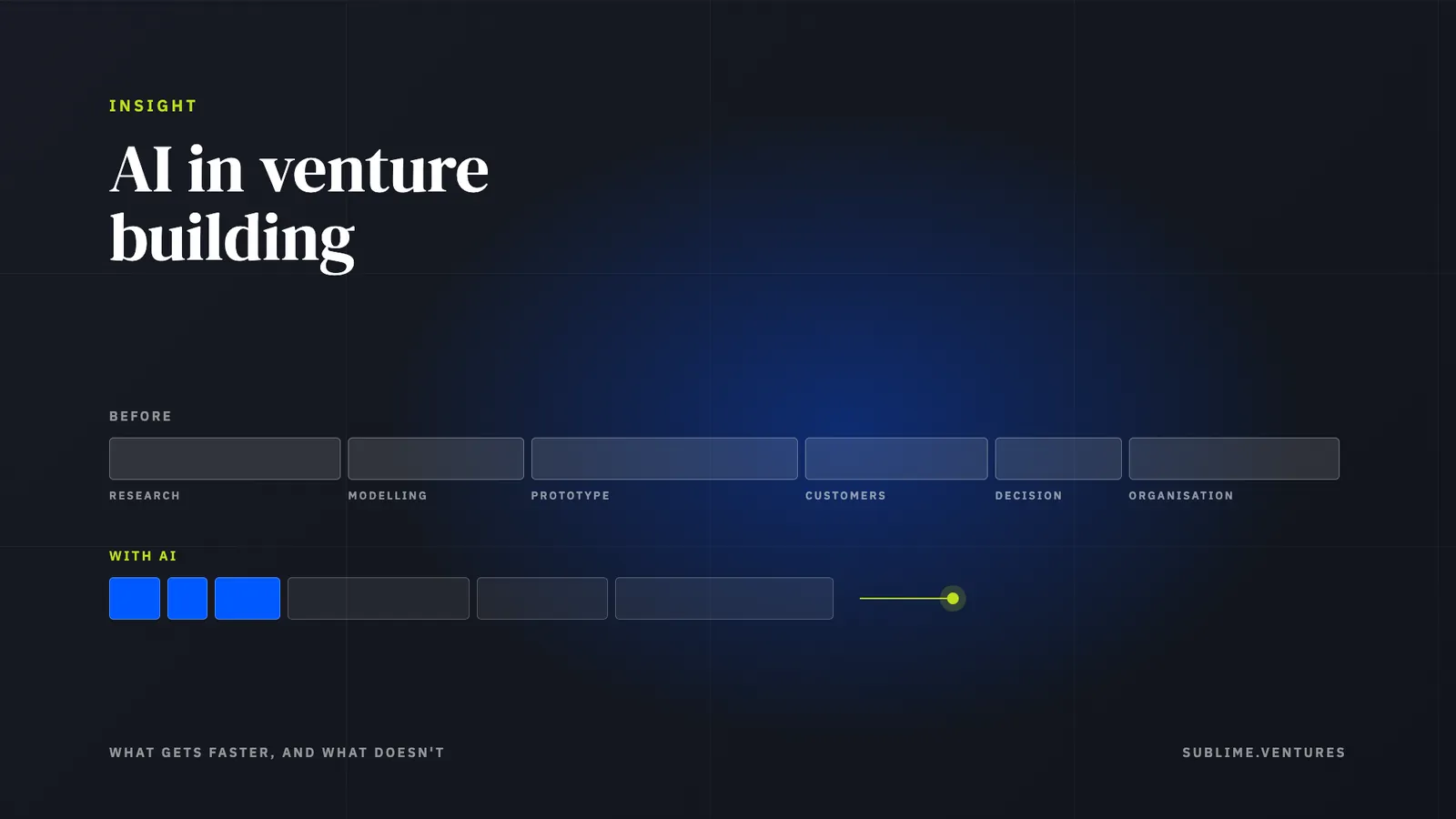
The first studies of AI at work, in 2023, used ChatGPT and GPT-4. The models have since improved at a pace few expected. METR, an institute that measures what AI systems can do, tracks how long a task a model can complete half the time, measured by the time a human expert would need. In March 2023 GPT-4 topped out at tasks of about three and a half minutes. By early 2026 the best models had reached about 12 hours: a jump of roughly two hundredfold in three years. The 2023 studies therefore say little about how far the triangle can break today.
Controlled experiments, however, always arrive a few months late, and none published so far uses the latest generation of models. The most useful for measuring progress compares models from different periods: more than 500 consultants, analysts and managers, each assigned to one of 13 models. The result: every year of model progress cuts the time needed to complete a task by 8%.
On quality, the strongest case is a study led by David Autor of MIT, carried out and funded by Google and published by the National Bureau of Economic Research in September 2026. For three months, 133 patent lawyers at eleven US law firms worked with or without an AI assistant, and their drafts were assessed blind by other lawyers. The quality of the drafts written with AI rose by about a third of a standard deviation, a clear improvement in a profession where mistakes are expensive. Another experiment, involving 1,174 adults working on a business problem, found that AI narrows the gap between the more and the less educated by three quarters.
And cost is collapsing. According to Epoch AI, an independent research group, reaching a given level of performance has become roughly 13 times cheaper each year since 2023: faster than any other technology the group has compared it with, from batteries to DNA sequencing.
Higher quality, shorter timelines, falling cost: on these numbers, the triangle is broken.
Where it really breaks: the frontier
In 2023 a team from Harvard, Wharton and MIT studied 758 consultants at Boston Consulting Group and coined a phrase that has stuck: the “jagged technological frontier”. The idea is simple. AI excels at some tasks and does poorly at others that look just as easy, and from the outside the line between the two cannot be seen. To show it, the researchers gave the consultants a problem built deliberately to fall beyond that line: those using AI got the right answer 19 percentage points less often than those working alone.
The line has moved a long way forward since then, but it is still there. The Remote Labor Index hands AI agents 240 real projects, already commissioned from freelancers, and counts how often the result is good enough for a client to accept. At launch, in October 2025, the best agent managed it 2.5% of the time; today the best reaches just over 21%. That is enormous progress, but it means a client would still turn down almost four pieces of work in five.
The same goes for the METR measurements mentioned above. The 12 hours are the length of task the best models complete half the time; in the other half, they fail. Ask for the task to succeed at least eight times in ten and the best models hold up only on work of an hour and a half.
This is where AI departs from Barnes’s triangle. When you cut time or cost, quality used to suffer visibly: a rushed job was easy to spot. With AI the mistake is invisible, because a wrong answer is as well written as a right one. Catching it takes someone who knows how to check.
The hidden corner: verification
The most instructive evidence comes from GDPval, a benchmark OpenAI published in October 2025: real tasks, written by professionals with an average of 14 years’ experience, across 44 occupations. On paper GPT-5 completed a task 90 times faster than an expert and 474 times more cheaply. The authors then simulated what usually happens inside a company: an expert reviews the output and, when it falls short, has the model try again or redoes the work. With that step included, the advantage shrinks to between 1.12 and 1.39 times on speed and between 1.18 and 1.63 times on cost. With a less capable model, GPT-4o, the work cost more and took longer once review was counted than doing it all by hand.
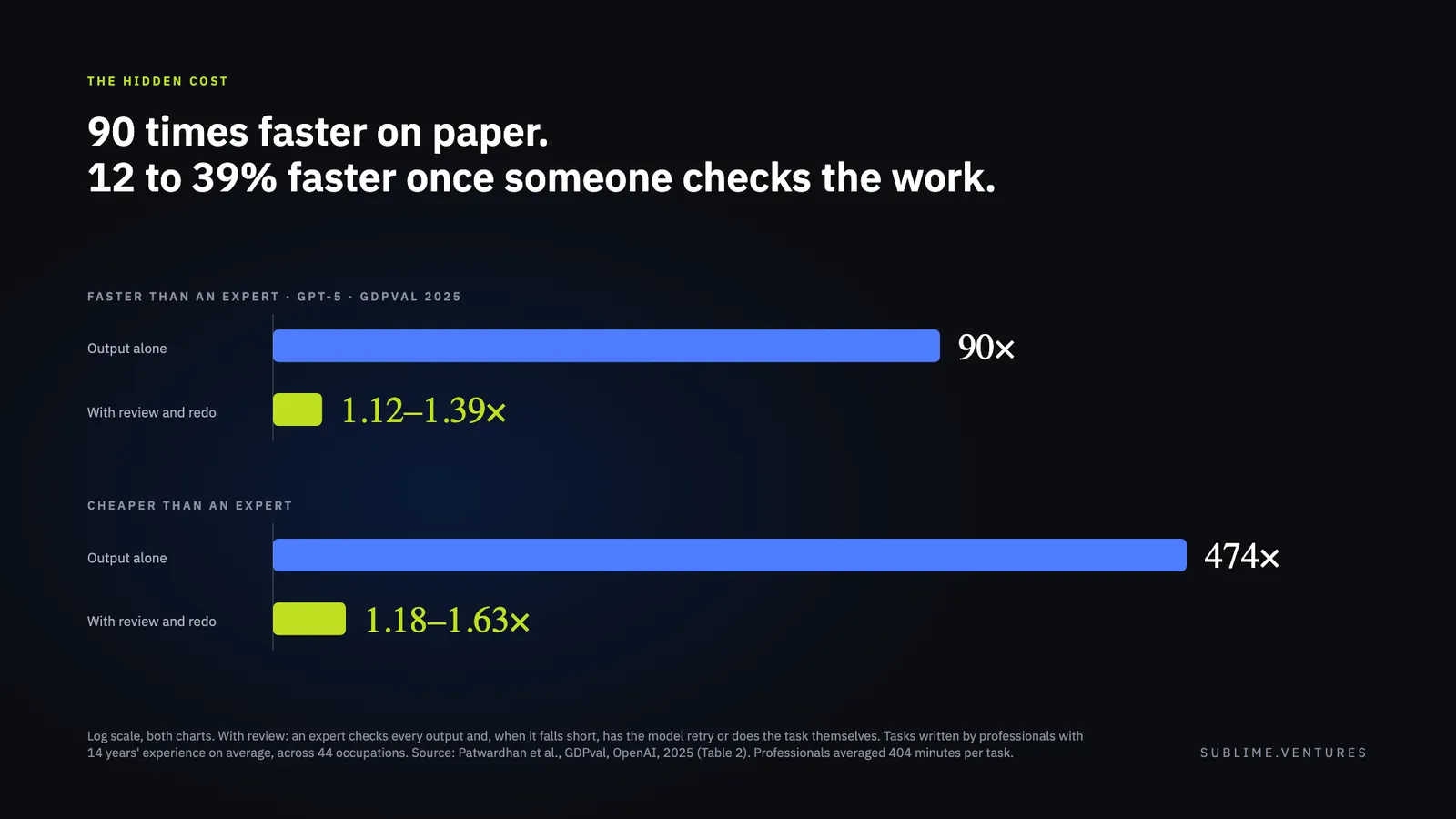
The models have improved in the meantime. In the original study GPT-5 beat the experts on 39% of tasks, while according to OpenAI GPT-5.5 beats or matches them on 84.9%. Fewer errors mean less rework, but the checking stays: nobody has yet rerun the calculation with the new models, and when verification is missing, the bill arrives later. In 2025 Deloitte Australia had to refund part of a government contract after its report was found to contain a fabricated quotation, attributed to a federal judge, and references to studies that do not exist.
So the triangle does not disappear. It changes corner. The constraint has moved away from production, which keeps getting cheaper, towards deciding what to produce and checking that it is right, which still takes hours of expert time.
What if today’s price isn’t the real one?
There is also a doubt hanging over the cost corner. Many of the companies selling AI are losing money, and plenty of it. According to the Wall Street Journal, OpenAI ended the first quarter of 2026 with $5.7bn in revenue and a $9.3bn operating loss, and the second with $6.7bn in revenue and a loss of $12.3bn: its losses are growing faster than its revenue. xAI, Elon Musk’s company, lost $2.5bn on revenue of $0.8bn in the first quarter, according to the prospectus for SpaceX’s listing. Investors are covering the gap.
Anthropic, the company that develops Claude, seems to be the exception. According to figures reported by Reuters, Bloomberg and the Financial Times, its revenue rose from $4.7bn in the first quarter to $11.6bn in the second and $16.8bn in the third, with an adjusted profit in both of the last two quarters. That result, though, excludes stock-based pay, which OpenAI does count, and the company does not give the amount. The full accounts tell a different story. The draft prospectus for its stock market listing, seen by the Wall Street Journal, shows a net loss of $80.7bn on revenue of $16.3bn for the first half of 2026. About $72bn of that is a non-cash accounting charge, tied to revaluing the convertible notes the company used to raise money: the higher its valuation climbs, the bigger the loss on paper. Strip out that charge and an $8.7bn loss remains, although that figure mixes operations with other items: the actual operating loss has not been disclosed. In the same half, however, spending on computing and infrastructure reached almost $9bn, more than the $7.3bn spent in the whole of 2025.
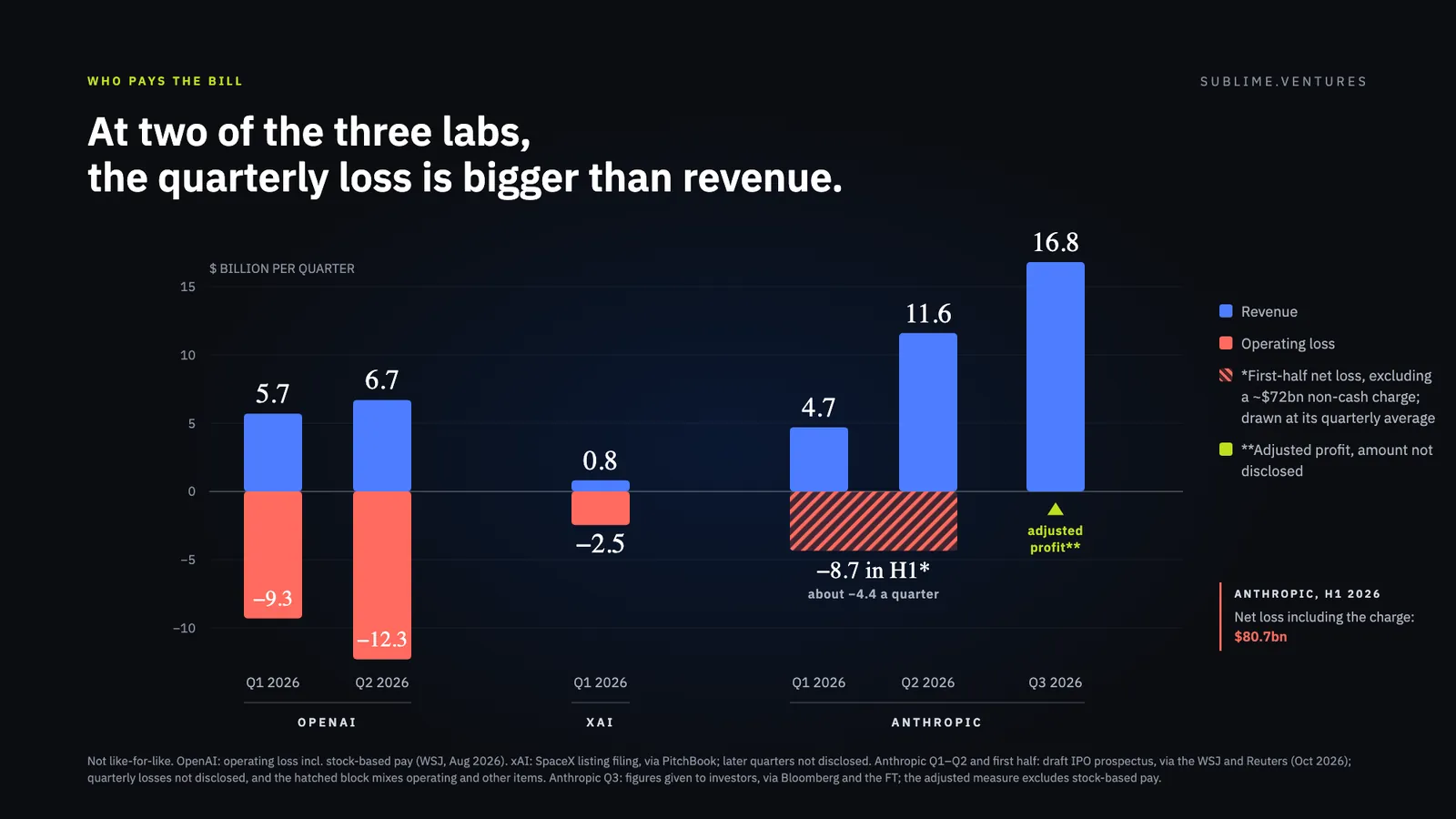
That does not hold for every single answer, though. Epoch AI estimates that while GPT-5 was OpenAI’s flagship, revenue covered the cost of serving users with a gross margin of around 30%; what failed to pay for itself was the research spending on developing the model in the first place. How much users pay relative to the real cost, however, nobody has reliably estimated.
The subsidy shows most clearly in flat-rate plans, and there the first retreats have already come. Since June 2026 GitHub Copilot has billed by usage, because the old model, its head of product Mario Rodriguez wrote, was no longer sustainable. And some flagship list prices have started rising again: according to OpenRouter’s measurements, users who moved to GPT-5.5 pay between 49% and 92% more per token than with GPT-5.4.
A general return to expensive AI is unlikely, because open models offered by many providers put a ceiling on the price of “good enough” AI. The risk lies with the best models and with agents that work for hours at a stretch. Anyone building a business that stands up only at today’s prices is betting that the support will last.
The corner that matters is who checks
What matters now is less which two corners to pick and more who decides what to do and who checks the work. The studies yield two practical rules.
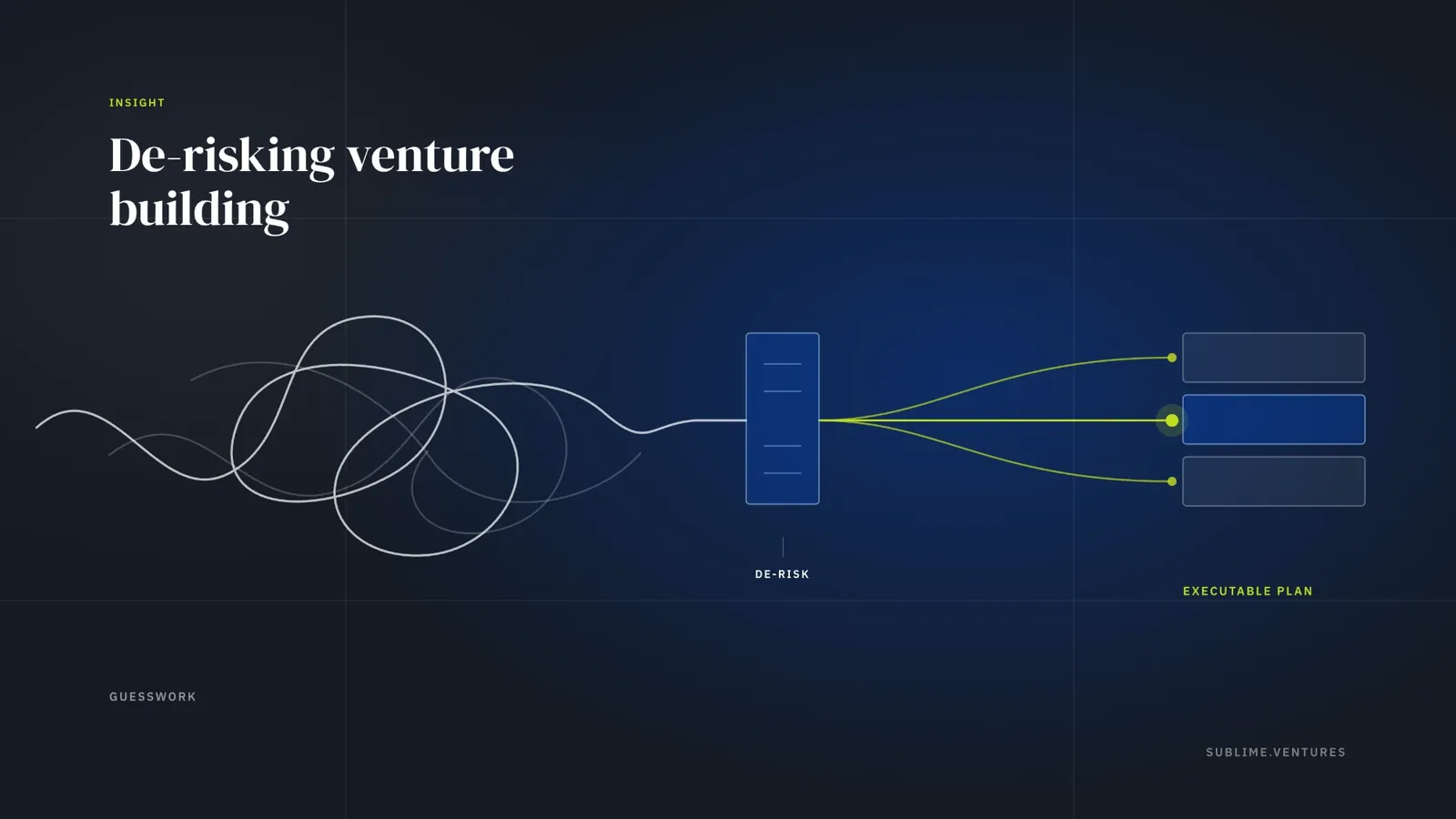
It is also the principle we start from at SUBLIME Ventures, as we explain in our article on de-risking new ventures.
Today Barnes’s coin can sit at the centre of the triangle. The hand holding it steady, though, still belongs to a person who can spot a mistake.